
Best Product Configurator for Fashion Brands in 2026: What Really Matters
Fashion brands are facing a critical inflection point in 2026. Rising customer acquisition costs, shrinking margins, and return rates that can exceed 40% for made-to-order items are forcing digital teams to rethink how they present and sell customizable products online. At the same time, consumer expectations have evolved: shoppers now demand the same visual fidelity and interactive experience they get from gaming and AR apps, but applied to real products they’re about to purchase.
This is where product configurators come in, but not all configurators are built for fashion. Generic 3D tools designed for industrial parts or furniture often fail to capture the nuance of fabrics, the complexity of garment construction, or the emotional decision-making process that drives fashion purchases. The result? High bounce rates, abandoned configurations, and a return rate that eats into profitability.
The best product configurators for fashion brands in 2026 do two things exceptionally well: they increase conversion through real-time 3D product customization that builds confidence in the purchase, and they reduce returns by giving customers accurate previews through virtual try-on technology and guided selling features. This article breaks down what matters when evaluating solutions, which features deliver measurable ROI, and how to choose a platform that aligns with your brand’s technical and commercial needs.
If you’re exploring options, understanding the capabilities of an AI-powered 3D configurator is a good starting point,but let’s first establish what makes a configurator truly fit for fashion use cases.

What is a product configurator for fashion brands
A product configurator for fashion is a digital tool that allows customers to customize garments, accessories, or footwear by selecting options such as fabrics, colors, trims, sizes, and design details,while visualizing their choices in real time. Unlike static product images or basic color swatches, a proper configurator renders each selection dynamically, showing exactly how the finished product will look before the customer adds it to cart.
The key difference between a generic configurator and one built for fashion lies in the depth of customization and the quality of visual representation. Fashion-oriented configurators must handle complex material properties (drape, texture, sheen), support extensive variant combinations (fabric × color × hardware × size × fit), and maintain performance across mobile devices where most shopping happens. They also need to account for the made-to-measure logic that many premium brands require, capturing body measurements, suggesting optimal fits, and translating those inputs into production-ready specifications.
A fashion product customization software worth considering should seamlessly integrate with your existing ecommerce stack through open API and ecommerce integrations for platforms like Shopify and WooCommerce, while providing the visual realism needed to replace traditional product photography for customizable items.
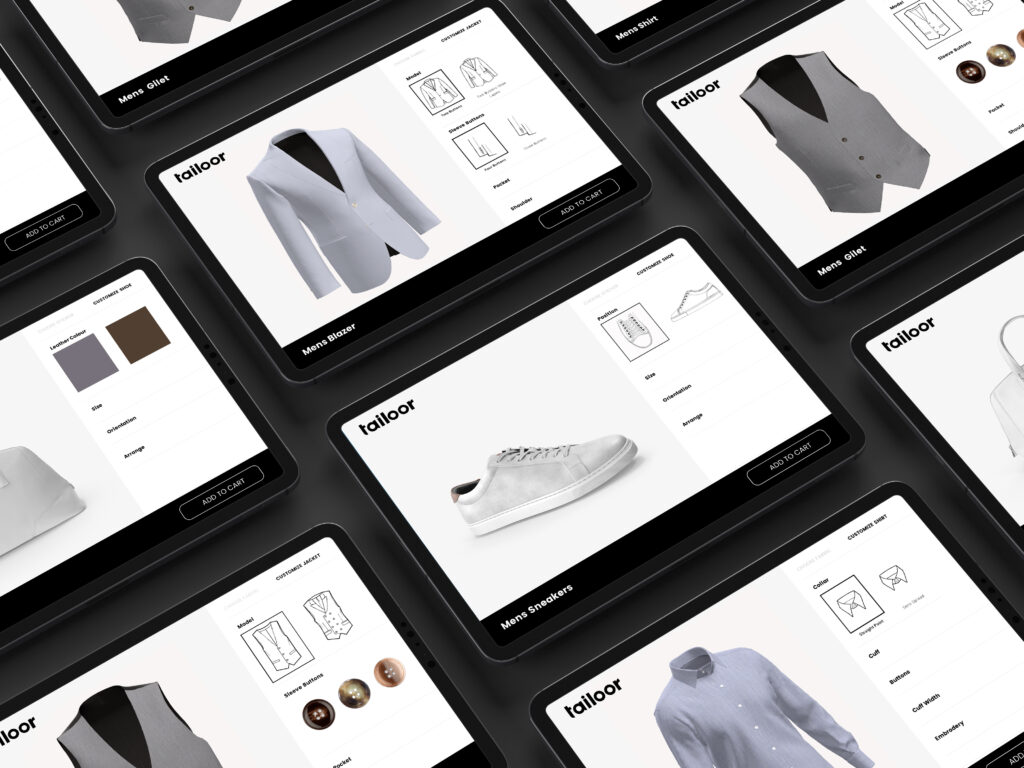
Key features that matter for fashion brands (2026)
Not all configurator features are created equally. Some are table stakes; others are genuine differentiators that impact conversion and customer satisfaction. Here’s what fashion brands should prioritize in 2026.
Real-time 3D product customization
Visual fidelity is not negotiable. Customers need to see their customizations rendered with photorealistic accuracy, how a silk charmeuse reflects light differently than a cotton twill, how contrast stitching appears on different base colors, how hardware finishes interact with fabric textures. This requires physically based rendering (PBR) and high-quality digital materials for realistic 3D visualization that capture the tactile qualities of real textiles.
Beyond static images, the configurator should support 360-degree rotation and multiple viewing angles so customers can inspect details the way they would in a physical store. Real-time rendering means zero lag between selection and visualization,critical for maintaining engagement and preventing drop-off during the configuration process.
Fabric and material variants
Fashion brands typically work with dozens or hundreds of fabric options, each with multiple colorways. A capable configurator manages this complexity through a robust materials library that categorizes fabrics by weight, composition, seasonality, and visual properties. It should allow for rule-based logic (e.g., certain linings only pair with specific shell fabrics) to prevent invalid combinations while still offering extensive creative freedom.
The system should also handle special treatments, embossing, printing, embroidery, appliqués,and show these accurately in the 3D render. Without this level of material management, you’re left with a glorified color picker that doesn’t reflect the true range of your offerings.
Virtual try-on and size confidence
Returns remain the biggest profitability drain for fashion ecommerce, particularly for customized items that can’t easily be resold. Virtual try-on for fashion addresses this by allowing customers to see how a garment looks on their body type or on avatars that match their measurements. This dramatically reduces size-related uncertainty,the primary driver of returns.
Advanced implementations use AI to recommend sizes based on body measurements, past purchase behavior, and fit preferences. Some systems even simulate how different fabrics will drape on different body shapes, providing an extra layer of confidence before purchasing. The goal is to reduce returns with virtual try-on technology that makes the digital experience informative as an in-store fitting.
Guided selling and AI assistant
Paradoxically, too much choice can paralyze customers. A jacket configurator with 30 fabric options, 10 lining choices, 8 button styles, and 15 customization details creates over 36,000 possible combinations,overwhelming for most shoppers. This is where an AI sales assistant for guided customization becomes essential.
Guided selling features can include curated starting points (seasonal collections, bestseller configurations), smart recommendations based on selections (“customers who chose this fabric often pair it with…”), and conversational AI that asks qualifying questions to narrow options. This reduces cognitive load, accelerates decision-making, and often increases average order value by surfacing premium options customers might not have discovered on their own.
Easy integrations and data infrastructure
A configurator doesn’t exist in isolation. It needs to feed data to your ecommerce platform, sync with inventory systems, communicate specifications to manufacturing partners, and track customer behavior for optimization. The best solutions offer open API and ecommerce integrations that work with Shopify, WooCommerce, and custom platforms without requiring months of developer resources.
Equally important is the analytics layer. You need visibility into which configurations are most popular, where customers get stuck in the customization flow, which fabrics have the highest attach rates, and how configurator usage correlates with conversion and return rates. And analytics dashboard and CRM for ecommerce teams should provide actionable insights that inform product development, marketing strategy, and UX improvements.
How to choose the right product configurator in 2026
Evaluating product configurator options requires looking beyond feature lists to assess actual capabilities and business fit. Use this checklist as a framework for comparing solutions.
Visual realism: PBR and digital materials
Ask vendors to demonstrate their rendering engine with your actual fabrics. Can they capture the difference between matte and satin finishes? Does the 3D model respond accurately to lighting changes? Is the level of detail sufficient to show texture and weave patterns? Request samples of digital materials for realistic 3D visualization using fabrics like yours.
Evaluate performance under real-world conditions,how quickly do renders update on mobile devices? Is the experience smooth or laggy? Visual quality means nothing if load times cause abandonment.
VTO accuracy and device support
Test the virtual try-on functionality across different devices and body types. How accurate are the size recommendations? Can customers upload their own photos or measurements? Does the system account for fabric properties in how it shows fit and drape?
Look for solutions that use AI-driven fit technology rather than simple avatar sizing. The more accurate the VTO, the greater the impact on returns.
Guided selling with AI and rules
Evaluate how the platform helps customers navigate complexity. Does it offer preset starting points or style archetypes? Can it make intelligent recommendations based on selections? Does it prevent invalid combinations while still allowing creative freedom?
Look for configurable business rules (bundle certain features, upsell premium options, seasonal promotions) and AI assistance that can answer questions or suggest alternatives.
Integrations and time-to-market
Assess the technical lift required for implementation. Does the platform offer pre-built connectors for your ecommerce platform? How does it handle product data sync? What’s required to feed configuration data to your manufacturing or fulfillment partners?
Get specific on timelines: how long from contract signature to live configurator? What internal resources are required? A powerful platform that takes 9 months to implement may be less valuable than a slightly simpler solution that launches in 6 weeks.
Dashboard, data, and success measurement
Understand what analytics come to standard. Can you track completion rates, popular configurations, drop-off points, and configuration-to-purchase conversion? Does the platform integrate with your existing analytics tools?
Look for vendors who can share benchmarks and case studies showing how other brands have measured and optimized their configurator performance over time. The best solutions include ongoing optimization as part of their offering.
Finally, request references from fashion brands with similar use cases. Ask about post-launch support, ongoing development, and how the vendor has helped them improve results over time.
Conclusion
The best product configurator for fashion brands in 2026 is one that balances visual excellence, customer guidance, and operational efficiency. It goes beyond basic 3D rendering to provide the confidence-building features,virtual try-on, AI assistance, realistic material visualization,that drive conversion and reduce returns. It integrates seamlessly with your existing ecommerce and production infrastructure, and it provides the data you need to continuously optimize the experience.
The brands that succeed with product configurators recognize that customization is not just a feature but a complete commercial strategy. It allows you to offer near-infinite variety without holding inventory, to command premium pricing through personalization, and to build deeper customer relationships by involving them in the creation process. .
As you evaluate options, focus on vendors who understand fashion-specific requirements and can demonstrate measurable results with comparable brands. Look for partners who will support you through implementation and optimization, not just deliver software, and disappear.
The investment in a proper configurator pays itself through higher conversion rates, lower return rates, increased average order values, and improved customer satisfaction. In a market where differentiation is increasingly difficult and customer acquisition costs continue to rise, giving customers the power to design exactly what they want, and the confidence to buy it, is a sustainable competitive advantage.
Book a demo to see how Tailoor can help you transform your fashion ecommerce experience with real-time 3D customization, virtual try-on, and AI-guided selling.