
AI-3D Configurator for Furniture & Design
In the Design & Furniture sector, the purchasing decision does not depend solely on a product's design — the customer's ability to imagine it within a real space matters significantly. Dimensions, proportions, materials, colors, and modularity must be understood with maximum precision before making a substantial investment.
Unlike other retail sectors, furnishing involves spatial and functional evaluations: the customer must understand how a sofa fits into the living area, how a bookcase interacts with the room's architecture, or how a modular kitchen adapts to available home measurements. According to Statista, the global online furniture market exceeded $430 billion in 2024. Provoke Insights reports that 77% of furniture purchases are planned, with 60% of consumers taking days or weeks before deciding.
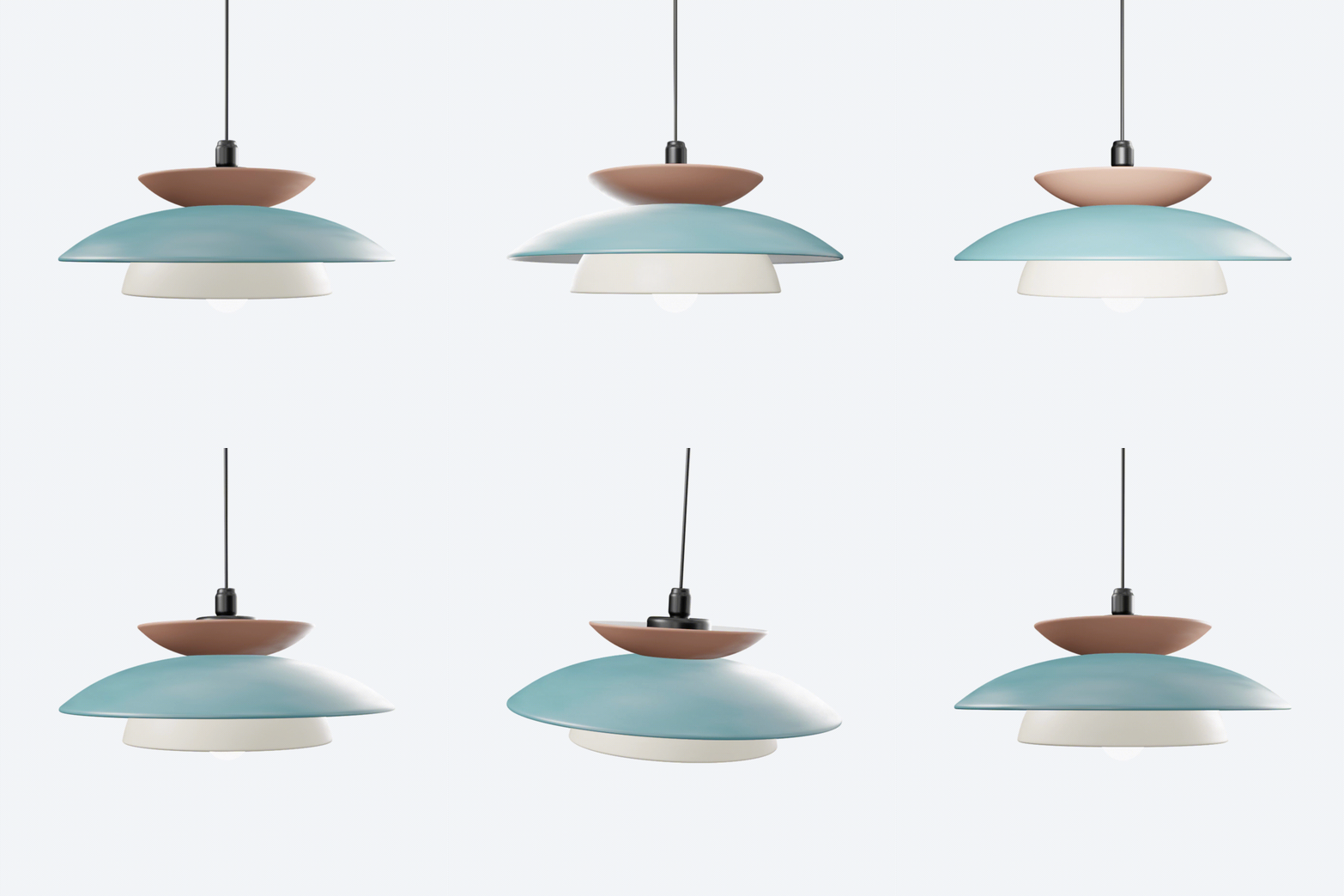
The Tailoor 3D Configurator introduces an advanced AI Product Configuration solution to the Design & Furniture sector — managing modular products, complex material variants, and highly customizable dimensions with photorealistic rendering of surfaces, textures, volumes, and proportions.
1. Why Configuration Has Become Central to Design & Furniture
In the furniture sector, the complexity of contemporary catalogs makes it increasingly difficult for customers to understand all available options through static photographs or traditional technical sheets. The PwC Global Consumer Insights Survey confirms that consumers place increasing value on personalized, customizable, and interactive digital experiences — especially for high-involvement categories like home and furniture.
2. From Physical Showroom to Digital Showroom
For decades, the purchasing experience in furniture was tied to the physical showroom. Today, over 40% of consumers who buy furniture online conduct in-depth research before finalizing a purchase, often comparing configurations and sizes across multiple sites. Digital visualization becomes an essential component of the shopping experience.
The classic showroom does not disappear — it is supported by a digital space increasingly capable of expanding the exploration phase to any device, any location, any time. Every customer who configures online arrives at the showroom with a clearer vision and a shorter path to purchase.
What digital configuration enables
- Explore catalogs with hundreds of variants
- Visualize realistic materials and color combinations
- Immediately understand dimensions and proportions
- Reduce the need for physical prototypes
The customer journey
3. User Experience & Conversion: Seeing Before Deciding
In furniture, visual understanding plays a vital role in the purchase decision. Unlike other products, furniture must be imagined within a domestic or professional space — and this visualization capability directly influences user trust. Shopify shows 3D and AR content drives conversion increases of up to +94% compared to static content.
4. Operational Impact: From Configuration to Production
Digital configuration modifies the entire internal functioning of design and furniture companies. Traditionally, configurations were managed manually through custom renderings, technical sheets, and mockups — time-consuming and error-prone. A 3D configurator integrated into workflows automates various process phases, reducing time-to-production and improving operational efficiency.
5 Measurable Benefits
- Elimination of Manual Renderings: No more custom mockups for every variant
- Increased Conversion: Up to +94% vs static content (Shopify)
- Automatic Bill of Materials Generation: Customer choices translate directly to production data
- ERP and CAD Integration: Seamless connection between configurator and enterprise systems
- Reduction of Interpretation Errors: Digital continuity eliminates miscommunication between customer and production
5. Use Cases: Brands, Designers, and Contract
3D configuration is useful not just for e-commerce but also for design and contract — the customization and realization of complete solutions for professional clients.
IKEA — Kitchen & Modular Planners
IKEA Planner lets users configure kitchens and modular systems based on real room measurements — a benchmark for accessible, consumer-facing 3D configuration at scale.
Herman Miller & Molteni&C
Both Herman Miller and Molteni&C use configurators to support designers and clients in defining complex systems — wardrobes, custom furniture — turning the configurator into a B2B collaboration tool.
Cosentino Visualizer
Cosentino offers a surface configurator to visualize finishes applied to kitchens and interiors — supporting both users and designers in evaluating chromatic and material combinations before realization.
Main use cases
› Modular furnishing systems configurable room by room (kitchen and living planners)
› Sectional kitchens with variants in materials, finishes, and custom dimensions
› Design accessories configurable in fabrics, colors, and construction details
› B2B configurators for architects and interior design firms
› Contract solutions for hotels, offices, and public spaces
6. KPIs and Value Metrics
7. Scalability and Managing Complex Catalogs
Design and furniture companies often manage extremely articulated catalogs — hundreds of variants linked to materials, sizes, and modular combinations. The Tailoor configurator automatically applies production rules and constraints to the user experience — making only configurations truly compatible with the catalog and production processes available.
Every configuration generated by the user is already consistent with available materials, permitted dimensions, and technical product specifications. This eliminates friction between the commercial phase and production — at any scale.
Frequently Asked Questions
Digital configuration accelerates the decision phase, improves product understanding, and transforms the configurator into a central tool — not just for sales, but for the entire design process.